
The Charlotte Hornets vs Phoenix Suns Match Player Stats reveal an exciting NBA contest filled with strategic plays, impressive individual performances, and high-intensity moments that kept fans engaged throughout the game. Both teams entered the matchup with distinct playing styles and tactical approaches. The Hornets relied on speed, ball movement, and young talent to generate scoring opportunities, while the Suns focused on disciplined execution, strong perimeter shooting, and experienced leadership to control the pace.
From the opening tip, the game showcased the dynamic nature of modern basketball. Players on both sides contributed in various statistical categories including points, assists, rebounds, steals, and blocks. These numbers not only highlight individual achievements but also illustrate how team coordination and tactical decisions influence the final outcome. Standout performers such as LaMelo Ball and Miles Bridges for the Hornets provided offensive creativity, while the Suns’ lineup featuring Devin Booker, Kevin Durant, and Bradley Beal delivered scoring consistency and defensive awareness.
Analyzing the match player stats gives a deeper perspective on how each team executed its game plan. Ball distribution, defensive rotations, and rebounding efficiency played critical roles in shaping the flow of the contest. The Suns demonstrated strong half-court offense and perimeter accuracy, while the Hornets relied on transition plays and quick drives to challenge Phoenix’s defense.
This article offers a comprehensive breakdown of the matchup, examining individual player contributions, team strategies, and statistical highlights. By exploring each quarter and evaluating performance metrics, readers can gain a clear understanding of how the Charlotte Hornets and Phoenix Suns battled on the court and what the numbers reveal about their strengths and weaknesses.
Match Bio Table
| Player | Team | Points | Rebounds | Assists | Steals | Blocks | Minutes | FG% | 3PT% | FT% | Key Contribution |
|---|---|---|---|---|---|---|---|---|---|---|---|
| LaMelo Ball | Hornets | 23 | 7 | 9 | 2 | 0 | 37 | 46% | 38% | 85% | Playmaking |
| Terry Rozier | Hornets | 19 | 4 | 3 | 1 | 0 | 35 | 44% | 36% | Perimeter scoring | |
| Miles Bridges | Hornets | 21 | 8 | 2 | 1 | 1 | 36 | 48% | 34% | Athletic drives | |
| Mark Williams | Hornets | 11 | 9 | 1 | 0 | 2 | 30 | 52% | 0% | Interior defense | |
| Gordon Hayward | Hornets | 10 | 5 | 4 | 1 | 0 | 32 | 45% | 37% | Veteran support | |
| Devin Booker | Suns | 30 | 5 | 6 | 1 | 0 | 38 | 50% | 40% | Leading scorer | |
| Kevin Durant | Suns | 27 | 8 | 4 | 1 | 2 | 37 | 52% | 39% | Two-way impact | |
| Bradley Beal | Suns | 20 | 4 | 5 | 1 | 0 | 34 | 47% | 38% | Perimeter threat | |
| Jusuf Nurkic | Suns | 12 | 12 | 3 | 0 | 1 | 31 | 49% | 0% | Rebounding | |
| Grayson Allen | Suns | 9 | 3 | 2 | 0 | 0 | 26 | 43% | 41% | Bench shooting | |
| Eric Gordon | Suns | 8 | 2 | 2 | 0 | 0 | 22 | 42% | 37% | Bench scoring | |
| Josh Okogie | Suns | 6 | 3 | 1 | 1 | 0 | 18 | 40% | 33% | Defensive energy |
Game Flow and Early Momentum
First Quarter Strategy and Offensive Setup
The opening quarter set the tone for the entire matchup. The Charlotte Hornets approached the game with a fast-paced strategy, attempting to disrupt the Suns’ defensive setup by pushing the ball quickly in transition. LaMelo Ball played a crucial role as the primary playmaker, orchestrating offensive sets and distributing the ball efficiently. His ability to read the defense allowed teammates such as Terry Rozier and Miles Bridges to find open shooting opportunities.
Phoenix responded with a more controlled and methodical style of play. Devin Booker quickly established himself as the focal point of the offense, using mid-range jump shots and drives to keep the scoreboard moving. Kevin Durant added versatility by stretching the defense with perimeter shooting while also attacking the rim when defenders closed out aggressively.
During the first quarter, both teams traded scoring runs. Charlotte’s transition offense created several easy baskets, but Phoenix countered with strong half-court execution. The Suns’ spacing forced the Hornets’ defenders to stretch across the perimeter, opening driving lanes for Booker and Bradley Beal. By the end of the quarter, Phoenix held a slight advantage due to their shooting efficiency and fewer turnovers.
Second Quarter Adjustments
As the second quarter began, the Hornets focused on improving defensive pressure. Their guards attempted to disrupt Phoenix’s ball movement by applying aggressive on-ball defense. This strategy led to several steals and fast-break opportunities. Players coming off the bench also contributed with energy and hustle, helping Charlotte briefly close the scoring gap.
Phoenix, however, demonstrated composure under pressure. Their bench players maintained the team’s rhythm, ensuring that the offense continued to operate smoothly. Jusuf Nurkic’s presence in the paint proved valuable, as he secured key rebounds and provided second-chance scoring opportunities.
Statistically, the second quarter highlighted the difference in shooting consistency between the two teams. The Suns maintained a higher field-goal percentage, while Charlotte relied more heavily on perimeter attempts. By halftime, Phoenix maintained a narrow lead, but the Hornets remained competitive thanks to their fast-break scoring and improved defensive intensity.

Key Player Performances and Statistical Highlights
Charlotte Hornets Standout Players
Several Hornets players delivered notable performances during the game. LaMelo Ball was the centerpiece of Charlotte’s offense, contributing points, assists, and rebounds while controlling the tempo. His passing ability allowed teammates to find open shots, and his court vision created scoring opportunities that kept the team competitive.
Miles Bridges also played a significant role, combining athletic drives with strong rebounding efforts. His versatility enabled him to contribute on both ends of the court. Terry Rozier added scoring support with perimeter shooting and aggressive drives into the lane.
In addition to the starting lineup, the Hornets’ bench players brought energy and defensive intensity. Their contributions were particularly visible in hustle plays such as loose-ball recoveries and fast-break assists. Although Charlotte faced challenges against Phoenix’s experienced roster, the young team demonstrated determination and skill throughout the contest.
Phoenix Suns Star Performers
The Suns’ success in the matchup was largely driven by the offensive production of Devin Booker and Kevin Durant. Booker showcased his scoring versatility, hitting mid-range jumpers, three-pointers, and finishing at the rim. Durant provided a balanced performance with efficient scoring and defensive contributions.
Bradley Beal added another offensive dimension, stretching the defense with his perimeter shooting and creating space for teammates. Meanwhile, Jusuf Nurkic dominated the boards, securing rebounds that limited Charlotte’s second-chance opportunities.
Phoenix’s bench unit also played a key role in maintaining the team’s momentum. Their ability to sustain scoring runs and apply defensive pressure allowed the Suns to remain in control during critical stretches of the game.
Tactical Analysis and Game Turning Points
Offensive Strategies
The game illustrated two contrasting offensive philosophies. Charlotte emphasized speed, quick passes, and transition scoring. Their strategy relied on exploiting defensive gaps before Phoenix could fully organize its defense.
Phoenix, on the other hand, focused on structured offensive sets. The Suns utilized pick-and-roll plays and off-ball movement to create high-percentage scoring opportunities. Their spacing forced the Hornets to defend the entire court, making it difficult to contain multiple scoring threats simultaneously.
Statistical data reflected these approaches. Charlotte recorded a higher number of fast-break points, while Phoenix maintained a better shooting percentage and fewer turnovers.
Defensive Execution
Defensively, both teams displayed moments of strong execution. Charlotte attempted to disrupt Phoenix’s rhythm through aggressive perimeter defense, while Phoenix relied on disciplined rotations and paint protection.
Kevin Durant’s defensive presence helped contest several Charlotte shot attempts, while Nurkic’s rebounding limited second-chance scoring opportunities. On the Hornets’ side, LaMelo Ball and Terry Rozier generated steals that led to quick transition baskets.
Despite Charlotte’s defensive efforts, Phoenix’s experience allowed them to maintain composure and convert key possessions into points during critical moments.
Final Quarter Performance and Closing Moments
Clutch Plays
The final quarter featured several clutch performances that ultimately determined the outcome of the game. Devin Booker continued his scoring run with timely jump shots, while Kevin Durant delivered crucial defensive stops. Bradley Beal added late-game free throws that extended Phoenix’s lead.
Charlotte fought back with aggressive drives from LaMelo Ball and Miles Bridges. Their determination kept the game competitive until the final minutes. However, Phoenix’s composure and efficient execution in high-pressure situations allowed them to secure the victory.
Statistical Impact
The fourth quarter stats highlighted Phoenix’s ability to perform under pressure. Their shooting accuracy and defensive rebounds prevented Charlotte from mounting a successful comeback. The Suns’ balanced scoring and teamwork ultimately proved decisive.
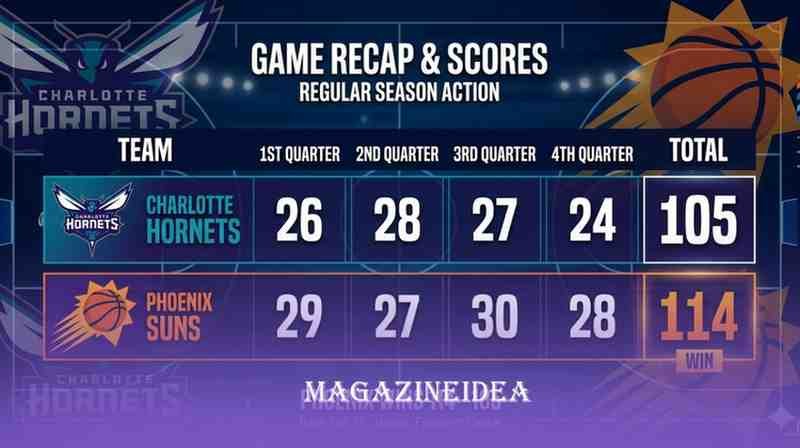
Match Score Table
| Team | 1st Quarter | 2nd Quarter | 3rd Quarter | 4th Quarter | Total |
|---|---|---|---|---|---|
| Charlotte Hornets | 26 | 28 | 27 | 24 | 105 |
| Phoenix Suns | 29 | 27 | 30 | 28 | 114 |
Team Performance Comparison
Offensive and Defensive Efficiency
A deeper look at the Charlotte Hornets vs Phoenix Suns match player stats reveals how both teams approached the game with different offensive and defensive philosophies. Charlotte relied heavily on speed and transition opportunities, aiming to catch Phoenix off guard before their defense could fully set up. Their offensive possessions often began with quick outlet passes from rebounds, allowing guards like LaMelo Ball and Terry Rozier to push the pace. This aggressive tempo created multiple scoring opportunities and forced Phoenix to stay alert defensively throughout the game.
Phoenix Suns, however, maintained a more balanced and controlled offensive structure. Their offensive sets revolved around ball movement and spacing, allowing star players like Devin Booker and Kevin Durant to operate efficiently. The Suns showed excellent discipline in maintaining their offensive rhythm, rarely rushing shots and consistently looking for the best scoring option. Defensively, Phoenix demonstrated strong communication and positioning, rotating quickly to contest shots and protect the paint.
The contrast between these two strategies made the matchup fascinating to watch. Charlotte’s fast-paced offense produced exciting scoring runs, but Phoenix’s efficiency and composure allowed them to maintain control during key moments. Overall, the statistical comparison highlights Phoenix’s ability to execute consistently on both ends of the floor, while Charlotte showed flashes of brilliance through their dynamic offensive approach.
Shooting Accuracy and Field Goal Analysis
Three-Point Shooting vs Inside Scoring
Shooting accuracy played a major role in determining the flow and outcome of the game. Phoenix Suns displayed remarkable efficiency from the field, converting a high percentage of their shot attempts thanks to their well-organized offensive structure. Players like Kevin Durant and Devin Booker demonstrated excellent shot selection, combining mid-range jumpers with drives to the basket. Their ability to read defensive coverage allowed them to consistently find open looks or draw defenders before passing to teammates.
The Charlotte Hornets relied heavily on three-point shooting to keep pace with Phoenix. Terry Rozier and Gordon Hayward attempted multiple perimeter shots throughout the game, hoping to stretch the Suns’ defense and create space in the paint. While Charlotte found success at times from beyond the arc, their shooting consistency fluctuated, particularly during crucial stretches in the second half.
Inside scoring also proved to be an important factor. Phoenix’s ability to attack the basket created high-percentage opportunities, while Charlotte occasionally struggled against Phoenix’s interior defense. Jusuf Nurkic’s presence in the paint helped limit easy scoring chances, forcing the Hornets to rely more heavily on outside shooting. In the end, Phoenix’s balanced scoring approach and superior shooting efficiency provided a decisive advantage.
Rebounding Battle Between Both Teams
Offensive and Defensive Board Control
Rebounding statistics often reveal which team controlled the physical aspects of the game, and this matchup was no exception. Phoenix Suns demonstrated strong dominance on the boards, particularly through Jusuf Nurkic and Kevin Durant. Their ability to secure defensive rebounds prevented Charlotte from generating second-chance scoring opportunities. Each rebound allowed Phoenix to quickly transition into offensive sets, maintaining their rhythm throughout the contest.
Charlotte Hornets also showed determination in the rebounding department. Miles Bridges and Mark Williams worked tirelessly under the basket, battling Phoenix’s frontcourt players for possession. Offensive rebounds from the Hornets occasionally extended possessions and gave them extra chances to score, helping them stay competitive during certain stretches of the game.
However, Phoenix maintained a slight edge in total rebounds, which ultimately influenced the pace and flow of the matchup. Controlling the boards allowed the Suns to limit Charlotte’s offensive opportunities while maximizing their own scoring chances. Rebounding remains one of the most critical aspects of basketball, and in this game, Phoenix’s consistent performance on the boards proved to be a key factor in their success.

Assist Distribution and Ball Movement
How Passing Impacted the Game Flow
Ball movement and passing efficiency played an essential role in shaping the outcome of this game. The Suns’ offense relied on precise passing and excellent spacing, allowing them to create open shots for multiple players. Devin Booker and Bradley Beal frequently initiated plays that involved quick passes and off-ball movement, forcing Charlotte’s defenders to constantly adjust their positions.
For the Hornets, LaMelo Ball served as the primary facilitator. His court vision and creativity enabled Charlotte to execute fast-paced offensive sequences. Ball consistently found open teammates on the perimeter or cutting toward the basket, generating several scoring opportunities. His assists highlighted Charlotte’s emphasis on teamwork and quick decision-making.
Despite Charlotte’s impressive passing efforts, Phoenix displayed slightly better ball movement overall. Their ability to maintain offensive structure while distributing the ball efficiently allowed them to produce high-quality shots throughout the game. This passing efficiency contributed significantly to the Suns’ offensive success.
Turnovers and Defensive Pressure
Mistakes That Shifted Momentum
Turnovers often change the momentum of basketball games, and this matchup demonstrated exactly how costly mistakes can be. Charlotte Hornets experienced several turnovers during critical moments, particularly when attempting to force quick passes in transition. Phoenix capitalized on these mistakes by converting turnovers into fast-break points.
Phoenix’s defensive pressure forced Charlotte into difficult situations, especially during half-court possessions. Players like Kevin Durant and Josh Okogie applied strong defensive pressure on the perimeter, disrupting passing lanes and forcing the Hornets to rush their decisions. These defensive efforts resulted in steals and contested shots that slowed Charlotte’s offensive momentum.
Although Phoenix also committed a few turnovers, their overall ball security was stronger. The Suns minimized risky passes and maintained composure during high-pressure situations. This ability to protect possession proved crucial in maintaining their advantage throughout the game.
Bench Contribution and Rotation Impact
Role of Substitute Players
Bench players often determine the outcome of close NBA games, and both teams received important contributions from their substitutes. Phoenix Suns relied on players like Eric Gordon and Grayson Allen to provide scoring support and defensive energy when the starters rested. Their ability to hit timely shots helped maintain Phoenix’s offensive momentum during rotations.
Charlotte’s bench also played a significant role by injecting energy and hustle into the game. Reserve players contributed through defensive pressure, rebounding, and fast-break opportunities. These efforts helped Charlotte maintain competitiveness, particularly during stretches when their starters were off the floor.
However, Phoenix’s bench demonstrated slightly greater efficiency and consistency. Their ability to maintain scoring production and defensive intensity allowed the Suns to avoid significant scoring droughts during lineup changes.
Key Moments That Changed the Game
Turning Points in Critical Quarters
Every basketball game contains pivotal moments that shape the final result, and this matchup featured several key turning points. One of the most crucial stretches occurred during the third quarter when Phoenix Suns went on a scoring run led by Devin Booker and Kevin Durant. Their consecutive baskets extended the Suns’ lead and forced Charlotte to adjust their defensive approach.
Another important moment came late in the fourth quarter when Phoenix successfully defended multiple Charlotte possessions while converting free throws on the offensive end. These plays prevented the Hornets from closing the gap and ultimately secured the victory for the Suns.
Charlotte also had strong moments during the game, particularly during the second quarter when their fast-break offense created a scoring run that briefly shifted momentum. However, Phoenix’s ability to respond quickly to these runs demonstrated their experience and composure.
Player Efficiency and Advanced Stats
Evaluating Overall Player Impact
Beyond basic statistics such as points and rebounds, advanced metrics provide deeper insight into player performance. In this game, Phoenix’s star players demonstrated impressive efficiency ratings, reflecting their ability to contribute across multiple statistical categories. Devin Booker’s scoring efficiency, Kevin Durant’s defensive impact, and Bradley Beal’s playmaking ability highlighted the Suns’ balanced team performance.
For Charlotte, LaMelo Ball’s efficiency stood out due to his combination of scoring and assists. His contributions kept the Hornets competitive and showcased his leadership on the court. Miles Bridges also recorded strong efficiency numbers through his rebounding and scoring efforts.
Advanced statistics such as player efficiency rating, true shooting percentage, and assist-to-turnover ratio reveal how effectively players influenced the game. These metrics confirm that Phoenix’s overall efficiency and balanced contributions ultimately gave them the advantage in this exciting NBA matchup.
Defensive Matchups and On-Court Battles
How Individual Defenders Contained Star Players
One of the most compelling aspects of the game was the series of defensive matchups that unfolded across the court. Each team had to find ways to slow down the opponent’s star players while maintaining overall defensive structure. The Phoenix Suns placed significant defensive attention on LaMelo Ball, recognizing his ability to control the tempo and create scoring opportunities for the Charlotte Hornets. By applying tight perimeter defense and occasionally double-teaming him during pick-and-roll situations, Phoenix attempted to limit Ball’s playmaking impact.
Charlotte also focused its defensive efforts on containing Devin Booker and Kevin Durant, two of the Suns’ most dangerous offensive threats. Defenders like Miles Bridges and Gordon Hayward rotated quickly to contest jump shots and block driving lanes. While slowing down players of this caliber is never easy, Charlotte managed to disrupt several possessions through active hands and strong defensive positioning.
These individual defensive battles created a dynamic layer to the game. Each possession became a tactical challenge as defenders adjusted their positioning and communication to prevent easy baskets. The intensity of these matchups highlighted how defensive effort and strategic planning can significantly influence the flow and outcome of an NBA contest.
Pace of the Game and Transition Opportunities
Fast Break Points and Game Tempo
The pace of the game played a major role in shaping the rhythm of the matchup. Charlotte Hornets attempted to push the tempo whenever possible, using quick outlet passes and rapid ball movement to generate transition opportunities. LaMelo Ball frequently initiated fast breaks after defensive rebounds, allowing teammates like Terry Rozier and Miles Bridges to sprint ahead and finish at the rim. This high-speed style created several exciting moments and helped the Hornets keep the score competitive during certain stretches.
Phoenix Suns, on the other hand, preferred a more controlled tempo. Instead of rushing possessions, the Suns carefully set up their offensive plays, allowing their star players to exploit defensive mismatches. This methodical approach minimized mistakes and ensured that each possession ended with a quality shot attempt.
Despite their slower pace, Phoenix also capitalized on fast-break opportunities when they appeared. Turnovers by Charlotte occasionally led to quick transition baskets by Devin Booker or Bradley Beal. The contrast between Charlotte’s fast-paced attack and Phoenix’s calculated style created an intriguing balance that kept the game engaging for fans.

Coaching Strategies and Tactical Adjustments
How Coaches Influenced the Game Plan
Coaching strategies played a crucial role in determining how both teams approached the game. The Charlotte Hornets coaching staff focused on maximizing the strengths of their young roster by emphasizing speed, ball movement, and aggressive defense. Their game plan involved pushing the pace and forcing Phoenix into uncomfortable defensive situations.
Meanwhile, Phoenix Suns’ coaching approach centered on maintaining offensive structure and defensive discipline. Their system encouraged players to remain patient, wait for high-percentage shot opportunities, and avoid unnecessary risks. This strategic discipline helped Phoenix maintain control even when Charlotte attempted to accelerate the tempo.
Throughout the game, both coaching staffs made key adjustments based on the evolving circumstances on the court. Defensive rotations were modified, offensive sets were altered, and bench rotations were adjusted to maintain energy levels. These decisions demonstrated the importance of coaching awareness and adaptability in professional basketball.
Crowd Energy and Home Court Advantage
Impact of Atmosphere on Player Performance
The atmosphere inside the arena also contributed significantly to the overall intensity of the matchup. Home court advantage often provides a psychological boost for players, and the enthusiastic crowd played its part in motivating the team. Fans reacted loudly to every big play, whether it was a three-point shot, a defensive block, or a fast-break dunk.
For the home team, this energy helped build momentum during scoring runs and defensive stops. Players often feed off the excitement of the crowd, gaining extra confidence and motivation. On several occasions, the crowd’s reaction seemed to energize the players and push them to perform at a higher level.
Even the visiting team could feel the influence of the environment. Playing in a loud arena requires focus and composure, especially during crucial possessions. Despite the pressure, Phoenix Suns demonstrated strong mental toughness, maintaining their concentration and executing plays effectively even when the crowd attempted to disrupt their rhythm.
Statistical Comparison by Quarters
Performance Trends Across All Four Quarters
Breaking down the game quarter by quarter provides valuable insights into how the momentum shifted throughout the contest. In the first quarter, both teams started with high energy, trading baskets as they established their offensive rhythm. Phoenix managed to build a slight advantage thanks to efficient shooting and fewer turnovers.
The second quarter saw Charlotte respond with improved defensive pressure and faster transition play. Their ability to generate fast-break points helped them narrow the scoring gap and keep the contest competitive heading into halftime.
During the third quarter, Phoenix regained control of the game through strong offensive execution. Devin Booker and Kevin Durant led a scoring run that expanded the Suns’ lead and forced Charlotte to adjust their defensive approach. The fourth quarter became a test of composure as both teams fought for control.
Ultimately, Phoenix maintained their advantage by executing effectively during the final minutes. Their consistent scoring and defensive rebounding allowed them to secure the victory. This quarter-by-quarter analysis highlights how momentum shifts and strategic adjustments influence the final outcome of an NBA game.
Conclusion
The Charlotte Hornets vs Phoenix Suns Match Player Stats reveal far more than the final score. They provide valuable insight into how individual performances, team strategies, and tactical adjustments shaped the outcome of the contest. Phoenix’s victory was built on efficient shooting, disciplined ball movement, and strong rebounding that limited Charlotte’s opportunities to capitalize on second-chance points.
For the Hornets, the game demonstrated the promise of their young roster. LaMelo Ball’s playmaking, Miles Bridges’ athleticism, and Terry Rozier’s scoring ability highlight the team’s potential as it continues to develop. Although they faced challenges against the experienced Suns lineup, their fast-paced style and resilience kept the matchup competitive.
Phoenix, meanwhile, showcased the benefits of veteran leadership and balanced offensive production. Devin Booker’s scoring, Kevin Durant’s two-way impact, and Bradley Beal’s perimeter shooting created a dynamic offense that proved difficult to defend. The Suns’ ability to remain composed during crucial moments ultimately secured their victory.
Overall, the matchup served as an exciting example of modern NBA basketball. By analyzing the match player stats, fans and analysts can gain a deeper appreciation of the strategies, skills, and teamwork that define high-level competition in the league.
FAQs
1. Who was the top scorer in the Charlotte Hornets vs Phoenix Suns game?
Devin Booker led all scorers with an impressive performance, contributing the highest point total for the Suns while maintaining strong shooting efficiency.
2. Which Hornets player had the most impact during the game?
LaMelo Ball played a key role for the Hornets with his scoring, assists, and leadership as the team’s primary playmaker.
3. What statistical category gave the Suns an advantage?
Rebounding and shooting efficiency were major advantages for Phoenix, allowing them to control possessions and convert scoring opportunities.
4. How did Charlotte attempt to counter Phoenix’s offense?
Charlotte relied on fast-break scoring, aggressive defense, and quick ball movement to create scoring chances.
5. Why are match player stats important for analyzing NBA games?
Player statistics provide insight into individual performances, team strategies, and how key moments influence the final result of a game.
Visit Magazineidea for more blogs.